threadman::Future<T> (one-shot), threadman::SharedFuture<T> (multi-shot), and threadman::Promise<T> — composable async result types with .then continuations dispatched through any executor.
More...
#include <threadman/exceptions.hpp>#include <threadman/log.hpp>#include <threadman/metrics.hpp>#include <threadman/stats.hpp>#include <commons/display_info.hpp>#include <atomic>#include <chrono>#include <condition_variable>#include <cstddef>#include <cstdint>#include <exception>#include <functional>#include <memory>#include <mutex>#include <optional>#include <type_traits>#include <utility>#include <vector>
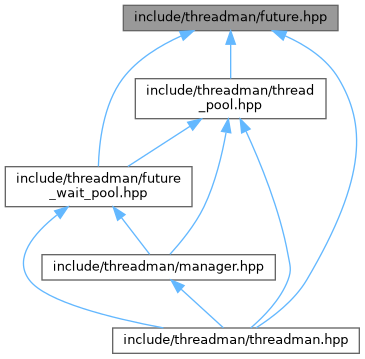
Go to the source code of this file.
Classes | |
| struct | threadman::detail::FutureSlot< T > |
| struct | threadman::detail::FutureSlot< void > |
| class | threadman::detail::FutureState< T > |
| class | threadman::Future< T > |
| class | threadman::SharedFuture< T > |
| class | threadman::Promise< T > |
Namespaces | |
| namespace | threadman |
| namespace | threadman::detail |
Functions | |
| void | threadman::detail::execute_on (IExecutor &exec, std::function< void()> task) |
Dispatch helper used by Future::then / SharedFuture::then. | |
Detailed Description
threadman::Future<T> (one-shot), threadman::SharedFuture<T> (multi-shot), and threadman::Promise<T> — composable async result types with .then continuations dispatched through any executor.
Both Future and SharedFuture are backed by a heap-resident detail::FutureState<T> held via std::shared_ptr. The state owns the result (or exception_ptr), the ready flag, and the list of registered continuations.
Future<T> is move-only and supports at most one .get() and one .then(); a second .then() throws ContinuationAlreadyRegisteredError. SharedFuture<T> is copyable and supports many .get()s and many .then()s — convert with Future::share().
Continuations are always dispatched via executor.execute(...) and never run synchronously on the satisfying thread, except through threadman::InlineExecutor (when the producer thread satisfies the promise and a continuation is already attached — the executor itself chooses to run inline). When a continuation is registered against an already-ready future, dispatch goes through the executor too (deferred, not on the calling thread).