Cached subsystem loggers for the tm.
More...
#include <logman/logman.hpp>#include <spdlog/spdlog.h>#include <memory>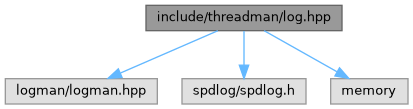
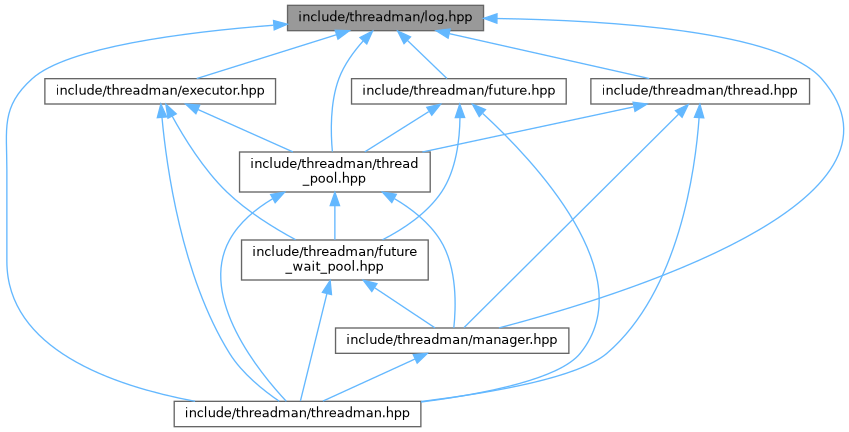
Go to the source code of this file.
Namespaces | |
| namespace | threadman |
| namespace | threadman::log |
Functions | |
| std::shared_ptr< spdlog::logger > & | threadman::log::pool () |
Logger for tm.pool — scaling, shutdown, queue back-pressure. | |
| std::shared_ptr< spdlog::logger > & | threadman::log::thread () |
Logger for tm.thread — ManagedThread lifecycle and faults. | |
| std::shared_ptr< spdlog::logger > & | threadman::log::future () |
Logger for tm.future — future satisfaction and continuation dispatch. | |
| std::shared_ptr< spdlog::logger > & | threadman::log::manager () |
Logger for tm.manager — housekeeper lifecycle, listener faults. | |
| std::shared_ptr< spdlog::logger > & | threadman::log::task () |
Logger for tm.task — stuck-task warnings (only when no listener subscribes). | |
| std::shared_ptr< spdlog::logger > & | threadman::log::executor () |
Logger for tm.executor — executor wiring and dispatch. | |
Detailed Description
Cached subsystem loggers for the tm.
* channels.
Each accessor returns a long-lived shared_ptr<spdlog::logger> created on first call via logman::get(...). The pointer is cached in a static-local, so subsequent calls are a no-op load; hot paths can additionally gate on lg->should_log(level) before evaluating a format string.
Logger initialization is the consumer application's responsibility — call logman::initialize(...) and (optionally) logman::set_levels_by_prefix( "tm.", level) once at startup. This header never calls initialize() itself; it just calls get(...), which lazily creates the channel using whatever defaults the application configured (or logman's built-in info- level default if none).