Loading...
Searching...
No Matches
json.hpp File Reference
Optional nlohmann/json integration for the Commons types. More...
#include <commons/config.hpp>#include <commons/color.hpp>#include <commons/display_info.hpp>#include <commons/fixed_string.hpp>#include <commons/flag.hpp>#include <commons/icon.hpp>#include <commons/id.hpp>#include <commons/origin.hpp>#include <commons/prioritized.hpp>#include <commons/semver.hpp>#include <commons/types.hpp>#include <commons/version_constraint.hpp>#include <nlohmann/json.hpp>#include <array>#include <complex>#include <concepts>#include <cstddef>#include <exception>#include <optional>#include <string>#include <type_traits>#include <utility>
Include dependency graph for json.hpp:

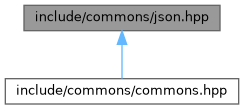
This graph shows which files directly or indirectly include this file:
Go to the source code of this file.
Detailed Description
Optional nlohmann/json integration for the Commons types.
The whole body is gated behind COMMONS_WITH_NLOHMANN_JSON (see commons/config.hpp): define it, or simply have <nlohmann/json.hpp> on the include path, and these hooks light up. The header is otherwise inert.
What it adds:
FixedString<N>⇄ JSON string. A string that does not fit the fixedNcapacity throws on parse.Color⇄ JSON hex string (#RRGGBB, or#RRGGBBAAwhen not opaque). A string that does not parse throws.Hsl/Hsv⇄ JSON objects ({"h","s","l","a"}/{"h","s","v","a"}).Icon⇄ JSON **set:namestring** (e.g."mdi:abacus"). A string that does not parse throws.DisplayInfo⇄ JSON object withname/description/icon/colorkeys; absent (std::nullopt) fields are omitted, andicon/colorreuse theIcon/Colormappings above.FlagRef⇄ JSON string (the flag name);FlagSet⇄ JSON array of names. Reading them back resolves each name against theGlobalFlagRegistry; an unknown name throws.i128/u128⇄ JSON decimal string. Plain JSON numbers cannot represent 128-bit integers without loss, so they travel as strings — a genuinely useful integration rather than a silent narrowing.std::optional<T>⇄ the innerT's JSON, withnullopt⇄ JSONnull.WithPriority<T>⇄ JSON object{"priority":N,"value":<T>}andPrioritizedSet<T>⇄ JSON array in sorted order — both only whenTis itself json-serializable; the set'sfrom_jsonadditionally requiresT's priority to be recoverable from the element.Id<Tag, Repr>⇄ the innerRepr's natural JSON (a number for the uint reprs, a string forstd::string, the ULID string when ULID is also enabled).
The fixed-width builtin aliases (i8…u64, f32, f64, usize, isize) need nothing here: nlohmann already serializes the underlying arithmetic types natively.