Loading...
Searching...
No Matches
macros.hpp File Reference
TAGVAL_* macros for declaring entries. More...
#include <tagval/entry.hpp>#include <tagval/kind_registry.hpp>#include <tagval/openended_registry.hpp> Include dependency graph for macros.hpp:
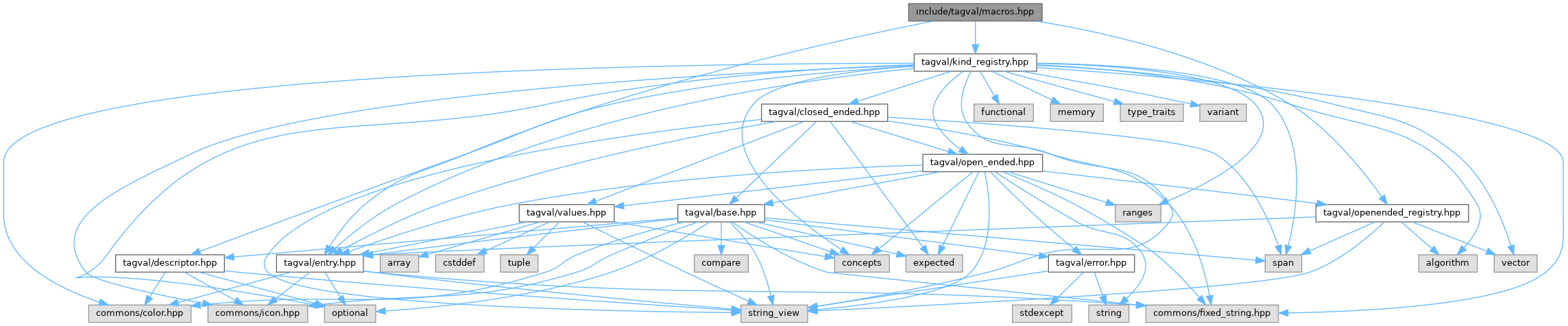 This graph shows which files directly or indirectly include this file: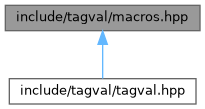
Go to the source code of this file.
Macros | |
| #define | TAGVAL_DETAIL_USED |
| #define | TAGVAL_ENTRY(Owner, TypeName, FuncName, ...) |
| #define | TAGVAL_ENTRY_AS(Owner, TypeName, FuncName, Code, ...) |
| #define | TAGVAL_EXTERN_ENTRY(Owner, TypeName, FuncName, ...) |
| #define | TAGVAL_EXTERN_ENTRY_AS(Owner, TypeName, FuncName, Code, ...) |
| #define | TAGVAL_DETAIL_PASTE2(a, b) a##b |
| #define | TAGVAL_DETAIL_PASTE(a, b) TAGVAL_DETAIL_PASTE2(a, b) |
| #define | TAGVAL_REGISTER_KIND(KindType) |
Detailed Description
TAGVAL_* macros for declaring entries.
In-class macros (TAGVAL_ENTRY, TAGVAL_ENTRY_AS) live inside the kind class body and declare a nested Entry type plus a static accessor. The kind must list these entries in values_t so they are visible to all_values() (ClosedEnded) or to the compile-time portion of an OpenEnded merge.
External macros (TAGVAL_EXTERN_ENTRY, TAGVAL_EXTERN_ENTRY_AS) live at namespace scope and always register into OpenEndedRegistry<Owner> — there is no other reason to declare an entry outside its class.
Macro Definition Documentation
◆ TAGVAL_DETAIL_USED
| #define TAGVAL_DETAIL_USED |
◆ TAGVAL_ENTRY
| #define TAGVAL_ENTRY | ( | Owner, | |
| TypeName, | |||
| FuncName, | |||
| ... | |||
| ) |
Value:
struct TypeName : ::tagval::Entry<Owner, #FuncName __VA_OPT__(, ) __VA_ARGS__> {}; \
[[maybe_unused]] [[nodiscard]] static auto const& FuncName() { \
return base_t::template value<TypeName>(); \
}
◆ TAGVAL_ENTRY_AS
| #define TAGVAL_ENTRY_AS | ( | Owner, | |
| TypeName, | |||
| FuncName, | |||
| Code, | |||
| ... | |||
| ) |
Value:
struct TypeName : ::tagval::Entry<Owner, Code __VA_OPT__(, ) __VA_ARGS__> {}; \
[[maybe_unused]] [[nodiscard]] static auto const& FuncName() { \
return base_t::template value<TypeName>(); \
}
◆ TAGVAL_EXTERN_ENTRY
| #define TAGVAL_EXTERN_ENTRY | ( | Owner, | |
| TypeName, | |||
| FuncName, | |||
| ... | |||
| ) |
Value:
struct TypeName : ::tagval::Entry<Owner, #FuncName __VA_OPT__(, ) __VA_ARGS__> {}; \
[[maybe_unused]] [[nodiscard]] inline auto const& FuncName() { \
return Owner::template value<TypeName>(); \
} \
/* NOLINTNEXTLINE(readability-identifier-naming) */ \
::tagval::OpenEndedRegistry<Owner>::add(&::tagval::metadata_v<TypeName>); \
return true; \
}()
◆ TAGVAL_EXTERN_ENTRY_AS
| #define TAGVAL_EXTERN_ENTRY_AS | ( | Owner, | |
| TypeName, | |||
| FuncName, | |||
| Code, | |||
| ... | |||
| ) |
Value:
struct TypeName : ::tagval::Entry<Owner, Code __VA_OPT__(, ) __VA_ARGS__> {}; \
[[maybe_unused]] [[nodiscard]] inline auto const& FuncName() { \
return Owner::template value<TypeName>(); \
} \
/* NOLINTNEXTLINE(readability-identifier-naming) */ \
::tagval::OpenEndedRegistry<Owner>::add(&::tagval::metadata_v<TypeName>); \
return true; \
}()
◆ TAGVAL_DETAIL_PASTE2
| #define TAGVAL_DETAIL_PASTE2 | ( | a, | |
| b | |||
| ) | a##b |
◆ TAGVAL_DETAIL_PASTE
| #define TAGVAL_DETAIL_PASTE | ( | a, | |
| b | |||
| ) | TAGVAL_DETAIL_PASTE2(a, b) |
◆ TAGVAL_REGISTER_KIND
| #define TAGVAL_REGISTER_KIND | ( | KindType | ) |
Value:
/* NOLINTNEXTLINE(readability-identifier-naming) */ \
tagval_kind_registered_, __LINE__) = [] { \
::tagval::KindRegistry::register_kind<KindType>(); \
return true; \
}()