Compile-time named flags grouped into categories, plus a runtime FlagSet, a program-wide GlobalFlagRegistry, and declaration macros.
More...
#include <commons/display_info.hpp>#include <commons/fixed_string.hpp>#include <commons/types.hpp>#include <algorithm>#include <concepts>#include <map>#include <optional>#include <string_view>#include <utility>#include <vector>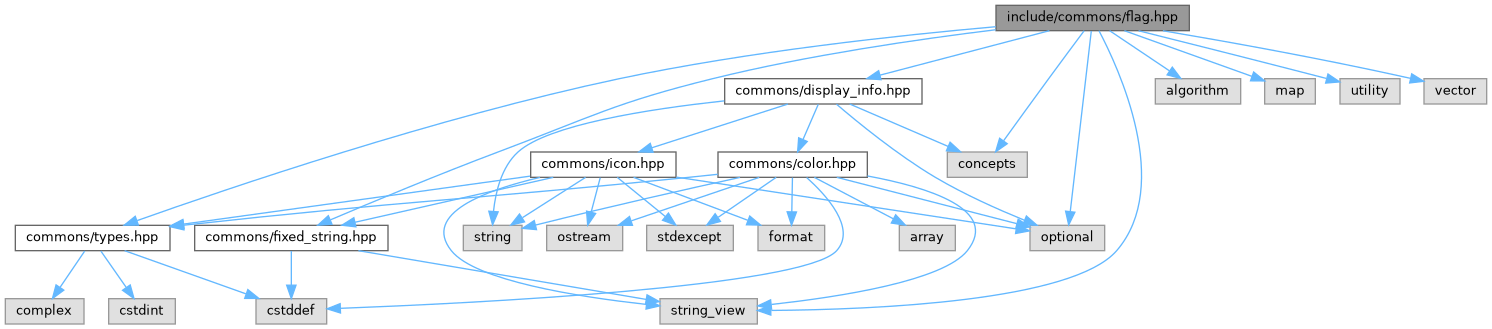
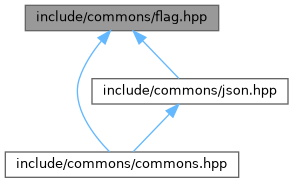
Go to the source code of this file.
Classes | |
| struct | comms::FlagCategory< Name > |
A flag category, identified by a FixedString name. More... | |
| struct | comms::UnsetFlagCategory |
The default category for a Flag declared without an explicit one. More... | |
| struct | comms::Flag< Name, Category > |
A compile-time flag: a distinct type named by Name and belonging to Category (defaulting to UnsetFlagCategory). More... | |
| struct | comms::FlagRef |
| A type-erased, non-owning runtime handle to a flag. More... | |
| class | comms::FlagSet |
| An insertion-ordered set of unique flags, deduplicated by name. More... | |
| class | comms::GlobalFlagRegistry |
| A program-wide registry of every known flag. More... | |
| struct | comms::FlagRegistrar< F > |
A self-registering object: constructing one registers F into the GlobalFlagRegistry. More... | |
| class | comms::IHasFlags |
Abstract read-only view of a type that owns a FlagSet. More... | |
| class | comms::HasFlags< Categories > |
Implementation of IHasFlags: embeds a FlagSet and exposes it publicly. More... | |
| class | comms::FlagBuilderMixin< Derived, Categories > |
| CRTP helper for builders. More... | |
| class | comms::FlagBuilderGetters< Derived, Categories > |
A builder that is also observable: combines FlagBuilderMixin's fluent mutators with a public, IHasFlags-backed read API. More... | |
Concepts | |
| concept | comms::AnyFlagCategory |
Any type that exposes a name convertible to std::string_view — satisfied by FlagCategory<Name> and types deriving from it. | |
| concept | comms::AnyFlag |
Any flag type: a name plus a category member type that is itself an AnyFlagCategory. | |
| concept | comms::FlagInCategory |
A flag whose category is exactly Category. | |
| concept | comms::AllowedFlag |
Whether flag F may go into a set constrained to Categories...: any flag when the list is empty (unconstrained), otherwise only flags whose category is one of Categories.... | |
Macros | |
| #define | COMMONS_FLAG_CATEGORY(Ident, Name) struct Ident : ::comms::FlagCategory<Name> {} |
Declare a flag category type Ident named Name. | |
| #define | COMMONS_FLAG(Ident, Name) struct Ident : ::comms::Flag<Name> {} |
Declare a flag type Ident named Name in UnsetFlagCategory. | |
| #define | COMMONS_FLAG_IN(Ident, Name, Cat) struct Ident : ::comms::Flag<Name, Cat> {} |
Declare a flag type Ident named Name in category Cat. | |
| #define | COMMONS_REGISTER_FLAG(Ident) inline const ::comms::FlagRegistrar<Ident> commons_flag_registrar_##Ident {} |
Register an already-defined flag type Ident into the GlobalFlagRegistry. | |
| #define | COMMONS_DEFINE_FLAG(Ident, Name) |
Define a flag type Ident named Name and auto-register it. | |
| #define | COMMONS_DEFINE_FLAG_IN(Ident, Name, Cat) |
Define a flag type Ident named Name in category Cat and auto-register it. | |
| #define | COMMONS_FLAG_FAMILY(CatIdent, Name, FlagTmpl, ConceptName) |
Declare a whole flag family in one line: a category CatIdent named Name, a per-category flag template FlagTmpl<N>, and a concept ConceptName satisfied by flags in that category. | |
Detailed Description
Compile-time named flags grouped into categories, plus a runtime FlagSet, a program-wide GlobalFlagRegistry, and declaration macros.
A comms::Flag<Name, Category> is a distinct type identified by a FixedString name and belonging to a comms::FlagCategory<Name> (defaulting to comms::UnsetFlagCategory). Both the name and the category name are exposed as static constexpr std::string_view members — mirroring IconifySet<Set>::set — so they live in the flag type's static, NTTP-backed storage and stay valid for the whole program.
A flag may carry presentation metadata: give it a static const DisplayInfo& display_info() member (see commons/display_info.hpp) and it becomes Displayable; FlagRef::of<F>() then captures a pointer to it. Flag does not inherit the display trait, so a plain flag is simply not Displayable.
comms::FlagRef is a type-erased, non-owning runtime handle (name + category + optional display pointer) whose views point at that static storage. comms::FlagSet is an insertion-ordered set of unique flags (deduplicated by name) exposing std::set-style methods plus group_by_category(). comms::GlobalFlagRegistry is a Meyers singleton that knows about every registered flag.
Flags self-register through the define macros (each emits a self-registering inline object) or explicitly via COMMONS_REGISTER_FLAG / GlobalFlagRegistry::add.
A small family of mixins lets a type own a FlagSet. comms::IHasFlags is the abstract read interface (flags() / has_flag()) for polymorphic access; comms::HasFlags<Categories...> implements it as a plain holder. comms::FlagBuilderMixin<Derived, Categories...> (CRTP) adds fluent set/insert/remove mutators returning Derived& while keeping read access private (a "silent" builder), and comms::FlagBuilderGetters<Derived, Categories...> combines those mutators with the public, IHasFlags-backed read API. Listing Categories... constrains the typed overloads to flags in those categories; an empty list accepts any flag.
Serialization (in commons/json.hpp, gated by COMMONS_WITH_NLOHMANN_JSON): a FlagRef travels as its name string and a FlagSet as a JSON array of names; reading them back resolves each name against the GlobalFlagRegistry.