Priorities for orderable things (adapters, transports, …) plus the helpers to sort them deterministically — the C++ analog of Spring's Ordered interface.
More...
#include <commons/types.hpp>#include <algorithm>#include <concepts>#include <cstddef>#include <functional>#include <initializer_list>#include <iterator>#include <limits>#include <memory>#include <set>#include <type_traits>#include <utility>
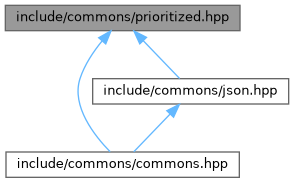
Go to the source code of this file.
Classes | |
| struct | comms::Prioritized |
| The orderable interface. More... | |
| struct | comms::PrioritizedCompare |
Orders std::shared_ptr<Prioritized> by ascending priority. More... | |
| struct | comms::LenientPrioritizedCompare< T > |
Like PrioritizedCompare, but over std::shared_ptr<T> for an arbitrary T that need not derive from Prioritized: the priority is resolved through get_priority (which handles Prioritizable types and a dynamic_cast probe). More... | |
| class | comms::PrioritizedSet< T > |
A set that behaves like std::set<T> from the outside — unique by T value, iterators yield const T&, every method is expressed in terms of T — but whose iteration order is (priority asc, insertion-order asc) rather than by T value. More... | |
| class | comms::PrioritizedSet< T >::const_iterator |
A thin bidirectional adapter over std::set<Item>::const_iterator that projects each Item to its const T& value — the private Item is never observable, so iteration looks exactly like a std::set<T>'s. More... | |
| class | comms::PrioritizedBuilder< Derived > |
CRTP mixin that makes Derived a Prioritized carrying a mutable priority, with fluent setters returning Derived& for chaining. More... | |
| class | comms::WithPriority< T > |
A value of T carrying a priority. More... | |
Concepts | |
| concept | comms::Prioritizable |
Any type exposing a priority() convertible to int — satisfied by types deriving from Prioritized and by any standalone type with the method. | |
| concept | comms::detail::PointerReturningGet |
A type whose .get() yields something pointer-like (a smart pointer). | |
Macros | |
| #define | COMMONS_PRIORITIZED_HIGHEST_PRECEDENCE (std::numeric_limits<int>::min()) |
Override for comms::Prioritized::HIGHEST_PRECEDENCE (default INT_MIN). | |
| #define | COMMONS_PRIORITIZED_LOWEST_PRECEDENCE (std::numeric_limits<int>::max()) |
Override for comms::Prioritized::LOWEST_PRECEDENCE (default INT_MAX). | |
| #define | COMMONS_PRIORITIZED_DEFAULT_PRIORITY 0 |
Override for comms::Prioritized::DEFAULT_PRIORITY (default 0). | |
Functions | |
| template<typename T > | |
| int | comms::detail::get_priority_ptr (const T *ptr) noexcept |
| Priority of a pointee. | |
| template<typename T > requires (!std::is_pointer_v<T>) | |
| int | comms::get_priority (const T &value) noexcept |
| Priority of a value or reference. | |
| template<typename T > | |
| int | comms::get_priority (const T *ptr) noexcept |
| Priority behind a raw pointer (null-safe). | |
| template<typename T > | |
| WithPriority< std::remove_cvref_t< T > > | comms::with_priority (int p, T &&item) |
Wrap item with priority p. | |
| template<typename T , typename... Args> | |
| std::shared_ptr< WithPriority< T > > | comms::make_prioritized (int p, Args &&... args) |
Make a shared_ptr<WithPriority<T>> (for use with the comparators / a std::set). | |
Variables | |
| template<typename T > | |
| constexpr bool | comms::with_priority_inherits = std::is_class_v<T> && !std::is_final_v<T> |
Whether WithPriority<T> attaches its priority by inheritance (a true is-a T): only for non-final class types. | |
Detailed Description
Priorities for orderable things (adapters, transports, …) plus the helpers to sort them deterministically — the C++ analog of Spring's Ordered interface.
Lower priority value sorts first (higher precedence), mirroring Spring: HIGHEST_PRECEDENCE is INT_MIN, LOWEST_PRECEDENCE is INT_MAX, and the neutral DEFAULT_PRIORITY is 0. The three sentinels are static constexpr members of comms::Prioritized; a build system or consumer may override them by predefining the matching COMMONS_PRIORITIZED_* macro (see below).
What this header provides:
comms::Prioritized— a virtual-with-default interface. A barestruct Adapter : comms::Prioritized {};already works atDEFAULT_PRIORITY; overridepriority()to change it.comms::Prioritizable<T>— concept for any type exposing.priority().comms::get_priority(x)— uniform priority lookup over values, references, raw pointers and smart pointers (null-safe), falling back toDEFAULT_PRIORITYwhen no priority is discoverable.comms::PrioritizedCompare/comms::LenientPrioritizedCompare<T>— strict-weak comparators overstd::shared_ptr(lower value first, with a stable pointer tie-break).comms::PrioritizedSet<T>— a transparentstd::set<T>(unique byTvalue) whose iteration order is(priority asc, insertion-order asc).comms::PrioritizedBuilder<Derived>— a CRTP mixin adding fluentpriority()/highest_priority()/lowest_priority()setters.comms::WithPriority<T>+with_priority/make_prioritized— attach a priority to an existing value, by inheritance for non-final classes (a true is-aT) or by composition otherwise.
Serialization (in commons/json.hpp, gated by COMMONS_WITH_NLOHMANN_JSON): WithPriority<T> travels as {"priority":N,"value":<T>} and a PrioritizedSet<T> as a JSON array in sorted order, both only when T is itself json-serializable. The interface and mixins carry no JSON hooks.
Function Documentation
◆ get_priority() [1/2]
requires (!std::is_pointer_v<T>)
|
inlinenoexcept |
Priority of a value or reference.
The Prioritized/Prioritizable branch is checked first so a Prioritizable type that also exposes .get() is not misrouted into the smart-pointer branch. Smart pointers forward to their pointee; anything else reports DEFAULT_PRIORITY. Constrained off raw pointers so those select the more specific overload below (template partial ordering alone does not reliably prefer it).
◆ get_priority() [2/2]
|
inlinenoexcept |
Priority behind a raw pointer (null-safe).
This overload is more specialized than the value/reference one, so a raw pointer argument selects it.
◆ get_priority_ptr()
|
inlineprotectednoexcept |
Priority of a pointee.
nullptr → default; a Prioritizable pointee answers directly; an unrelated polymorphic pointee is probed via dynamic_cast (the is_polymorphic_v guard keeps the cast well-formed for non-polymorphic T); otherwise the default. noexcept: a pointer dynamic_cast cannot throw.
◆ make_prioritized()
| std::shared_ptr< WithPriority< T > > comms::make_prioritized | ( | int | p, |
| Args &&... | args | ||
| ) |
Make a shared_ptr<WithPriority<T>> (for use with the comparators / a std::set).
The first argument is the priority; the rest construct the T.
◆ with_priority()
| WithPriority< std::remove_cvref_t< T > > comms::with_priority | ( | int | p, |
| T && | item | ||
| ) |
Wrap item with priority p.
The wrapper's T is std::remove_cvref_t<T>, chosen by with_priority_inherits between the inheritance and composition flavors.
Variable Documentation
◆ with_priority_inherits
|
inlineconstexpr |
Whether WithPriority<T> attaches its priority by inheritance (a true is-a T): only for non-final class types.
Final classes and fundamentals fall back to composition.