
Webhooks in and out
Inbound webhooks let other services send events without a Pulse credential: pulsed verifies the sender's signature and publishes the request body as an event. Outbound webhooks deliver events to your own HTTP endpoints, signed, in order and with retries. Both are managed on the Webhooks page.
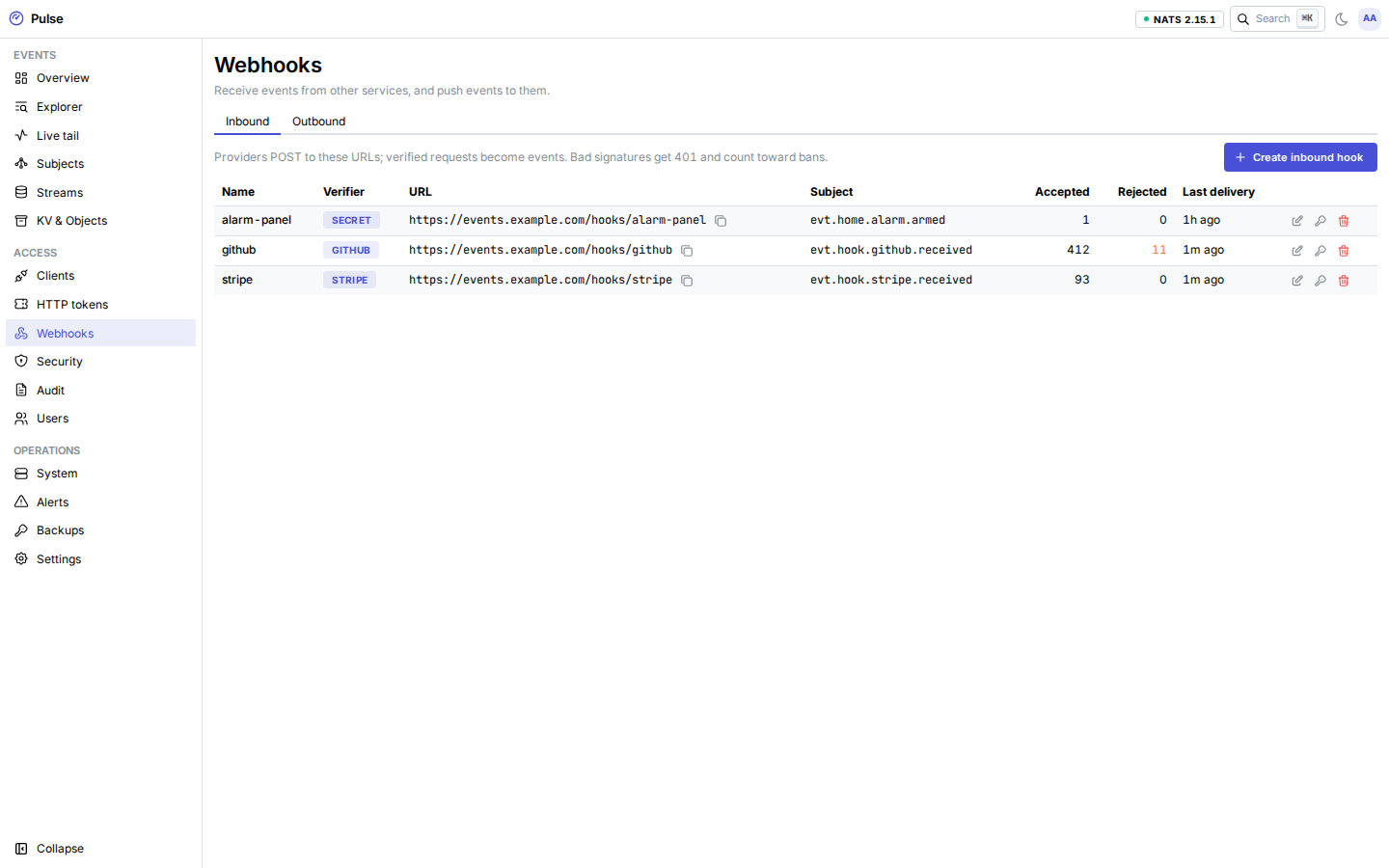
Inbound
Each inbound hook has a name, a verifier, a secret and a subject. The sender posts to:
https://events.example.com/hooks/<name>| Response | Meaning |
|---|---|
202 {"seq": N, "duplicate": bool} | Verified and stored. |
401 | Missing or bad signature. No detail is given, and the failure counts towards a ban of the sender's address. |
404 | Unknown or disabled hook. |
413 | Body too large: above 1 MiB (the NATS max_payload) a verified body cannot be stored; above 5 MiB the request is cut off. |
503 | Not stored: NATS is temporarily unavailable. |
The event goes to the hook's subject, by default evt.hook.<name>.received. Its source is hook:<name>, the body is the payload unchanged, and the content type is the request's.
Verifiers
| Verifier | What it checks | Event type and ID |
|---|---|---|
github | X-Hub-Signature-256: sha256=<hex HMAC-SHA256(secret, body)> | type github.<X-GitHub-Event>; ID X-GitHub-Delivery, so redeliveries within 2 minutes are stored once. The GitHub event, delivery and hook ID headers are kept. |
stripe | Stripe-Signature: t=…,v1=… over <t>.<body>; any v1 may match; t within 5 minutes | type stripe.<type>; ID the Stripe event id |
hmac | HMAC-SHA256 in a header you choose (default X-Signature), hex or base64, with an optional prefix such as sha256=; optionally a timestamp header, in which case the signed message is <ts>.<body> and the timestamp must be within the tolerance (default 300 s) | type from the hook's config, else hook.<name>; ID from Idempotency-Key |
secret | A shared secret compared in constant time against a header (default X-Webhook-Secret) | as hmac |
Use secret only when the sender cannot sign: it has no replay protection, and anyone who sees one request can send more. Prefer hmac with a timestamp header for your own senders.
When you create a hook you can paste the provider's secret (at least 16 characters) or let pulsed generate one. The secret is shown once, stored sealed with the master key, and can be rotated.
Setting up senders
GitHub (repository or organization → Settings → Webhooks → Add webhook):
- Create an inbound hook named
githubwith verifiergithuband copy the generated secret. - Payload URL
https://events.example.com/hooks/github, content typeapplication/json, the secret, and the events you want. - GitHub's ping arrives as type
github.ping. A push arrives asgithub.pushonevt.hook.github.received, or on the subject you set, e.g.evt.github.repo.push.go-pulse(one hook per repository).
Stripe (Developers → Webhooks → Add endpoint):
- Endpoint URL
https://events.example.com/hooks/stripe; Stripe shows a signing secretwhsec_…. - Create an inbound hook named
stripewith verifierstripeand paste that secret.
Your own sender with hmac and a timestamp header X-Timestamp:
body='{"backup":"ok"}'; ts=$(date +%s)
sig=$(printf '%s.%s' "$ts" "$body" | openssl dgst -sha256 -hmac "$HOOK_SECRET" -hex | sed 's/^.* //')
curl -fsS -X POST https://events.example.com/hooks/nas-backup \
  -H "Content-Type: application/json" -H "X-Timestamp: $ts" -H "X-Signature: $sig" \
  -H "Idempotency-Key: nas-$(date +%F)" -d "$body"
Cloudflare sits in front of /hooks/*. If a provider's requests are blocked, check the WAF events for that hostname.
Outbound
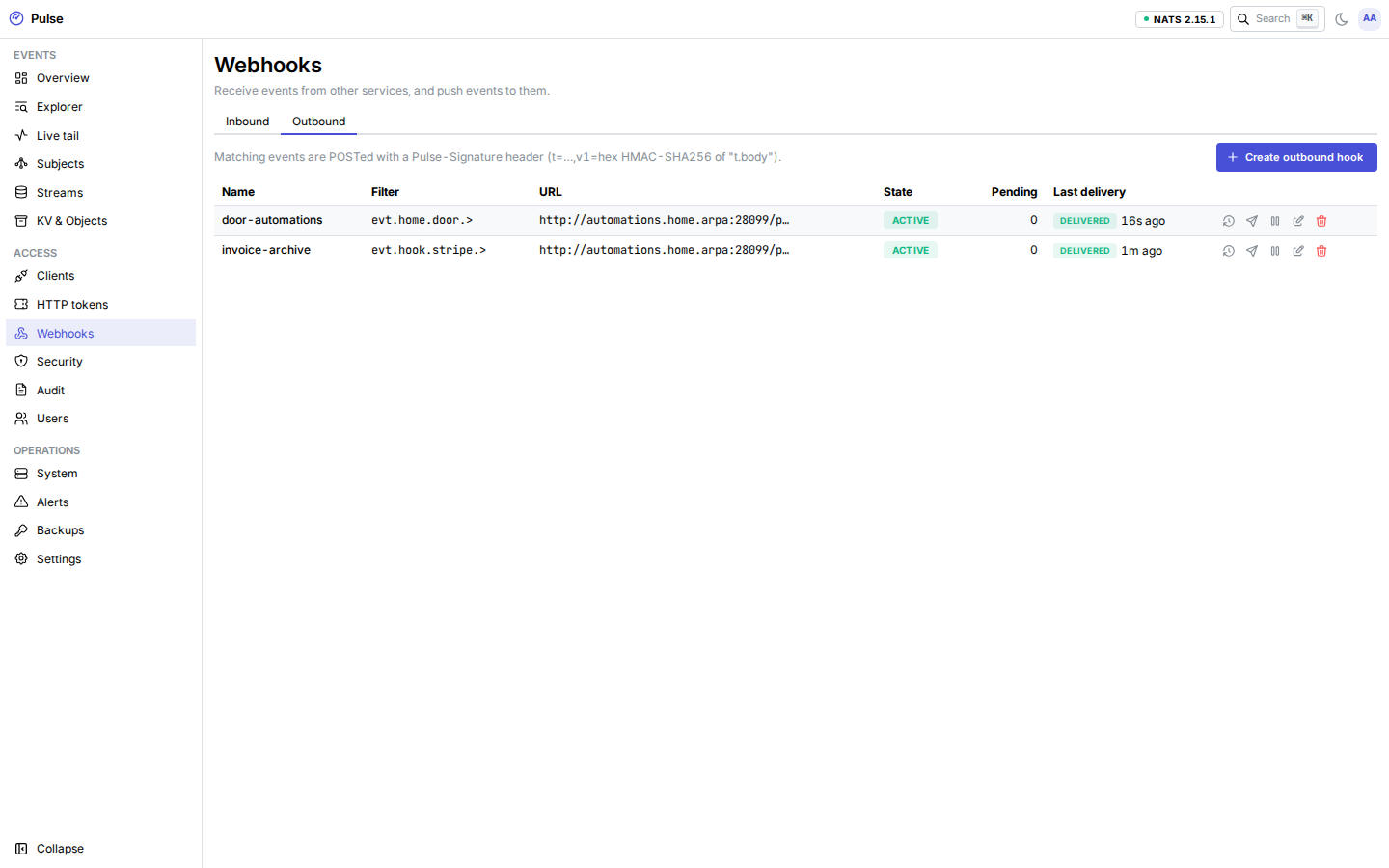
Each outbound hook has a name, a filter under evt.> (e.g. evt.home.door.>), a destination URL, optional extra headers and a signing secret (whsec_…, generated unless you set one; shown once). It is a durable consumer on EVENTS that starts with events published after the hook is created and delivers one event at a time, in stream order.
The request
POST <url> with the event payload as the body and the event's content type, plus:
| Header | Value |
|---|---|
Pulse-Signature | t=<unix seconds>,v1=<hex HMAC-SHA256(secret, "<t>.<body>")> |
Pulse-Event-Id | The event ID; use it to de-duplicate |
Pulse-Event-Type, Pulse-Event-Source, Pulse-Event-Time | The envelope (when set) |
Pulse-Subject, Pulse-Stream-Seq | Where it was stored |
Pulse-Delivery-Attempt | 1 for the first attempt |
| your extra headers | as configured |
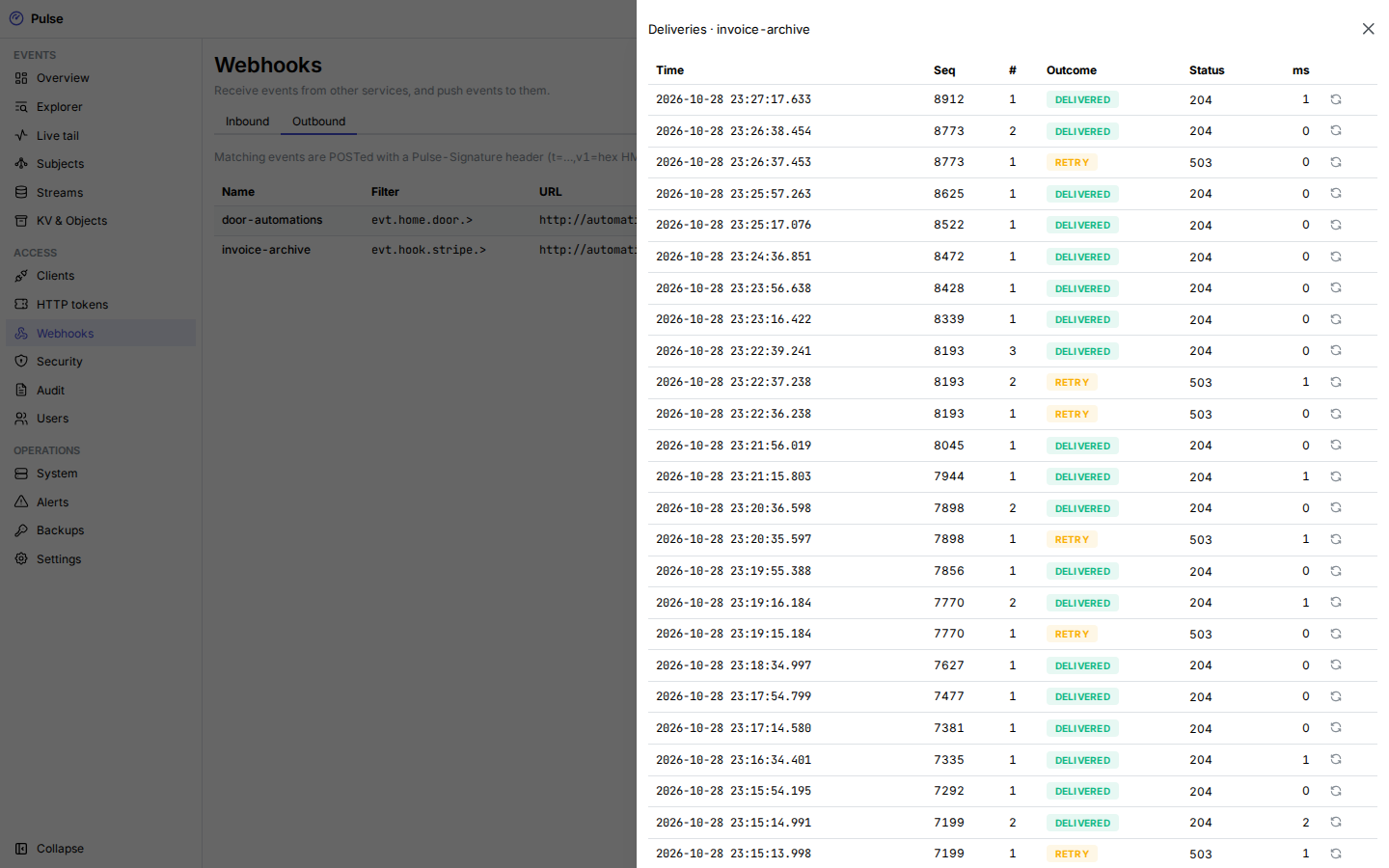
Any 2xx within 10 seconds acknowledges the event. Anything else is retried after 1 s, 2 s, 5 s, 15 s, 30 s, 1 min, 5 min, 10 min, 20 min, 40 min and 1 h: 12 attempts over a little more than two hours. After the last one, the event is recorded as dead, the dead_letters alert fires, and the hook moves on. Because delivery is in order, a failing endpoint holds back later events until it recovers or the event dies.
Delivery is at least once: de-duplicate on Pulse-Event-Id.
Verifying the signature
Check the HMAC over the raw body, compare in constant time, and reject old timestamps:
func verify(secret []byte, r *http.Request, body []byte) bool {
	var ts, sig string
	for _, part := range strings.Split(r.Header.Get("Pulse-Signature"), ",") {
		if v, ok := strings.CutPrefix(part, "t="); ok {
			ts = v
		} else if v, ok := strings.CutPrefix(part, "v1="); ok {
			sig = v
		}
	}
	t, err := strconv.ParseInt(ts, 10, 64)
	if err != nil || time.Since(time.Unix(t, 0)).Abs() > 5*time.Minute {
		return false
	}
	m := hmac.New(sha256.New, secret) // the whole secret string, including "whsec_"
	m.Write([]byte(ts + "."))
	m.Write(body)
	want := hex.EncodeToString(m.Sum(nil))
	return hmac.Equal([]byte(want), []byte(sig))
}import hashlib, hmac, time
def verify(secret: bytes, header: str, body: bytes) -> bool:
parts = dict(p.split("=", 1) for p in header.split(",") if "=" in p)
ts, sig = parts.get("t", ""), parts.get("v1", "")
if not ts.isdigit() or abs(time.time() - int(ts)) > 300:
return False
want = hmac.new(secret, f"{ts}.".encode() + body, hashlib.sha256).hexdigest()
return hmac.compare_digest(want, sig)Retries are signed again with a fresh timestamp.
Managing deliveries
On the Webhooks page, per outbound hook: pending events, the last delivery, the delivery log (attempt, outcome, status code, latency, a short response excerpt), pause and resume, send a test event, and retry a dead delivery. Error messages in the log never include the destination URL, since URLs often carry secrets.
Destinations Pulse refuses
To prevent server-side request forgery, pulsed checks the resolved address of every connection, including after redirects. Loopback, private (RFC 1918, ULA), link-local, CGNAT, multicast and cloud metadata addresses are refused. To deliver to a service on your own network, allowlist it with PULSE_OUTBOUND_ALLOW (IPs or CIDRs); see the configuration reference.