Clients and grants
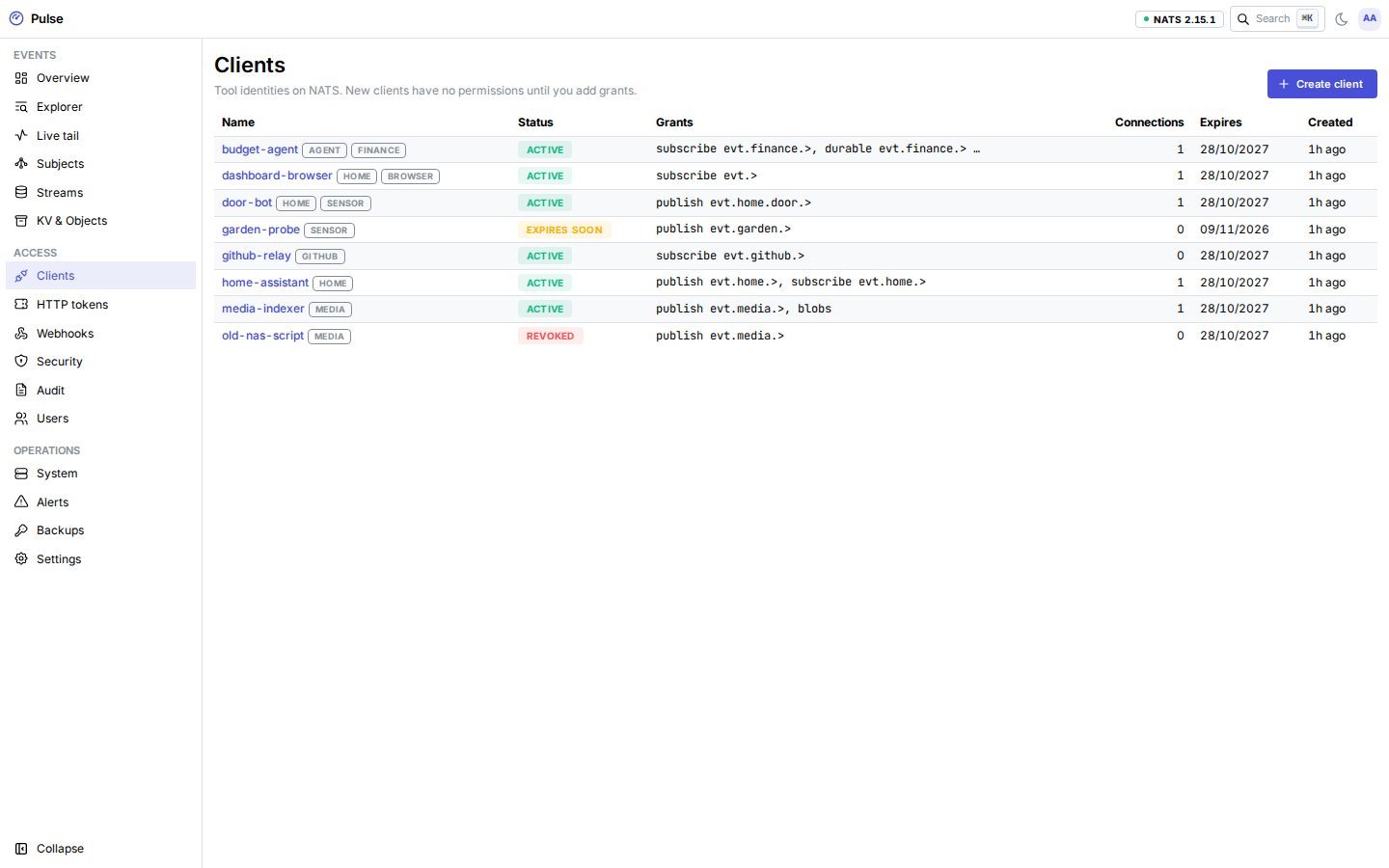
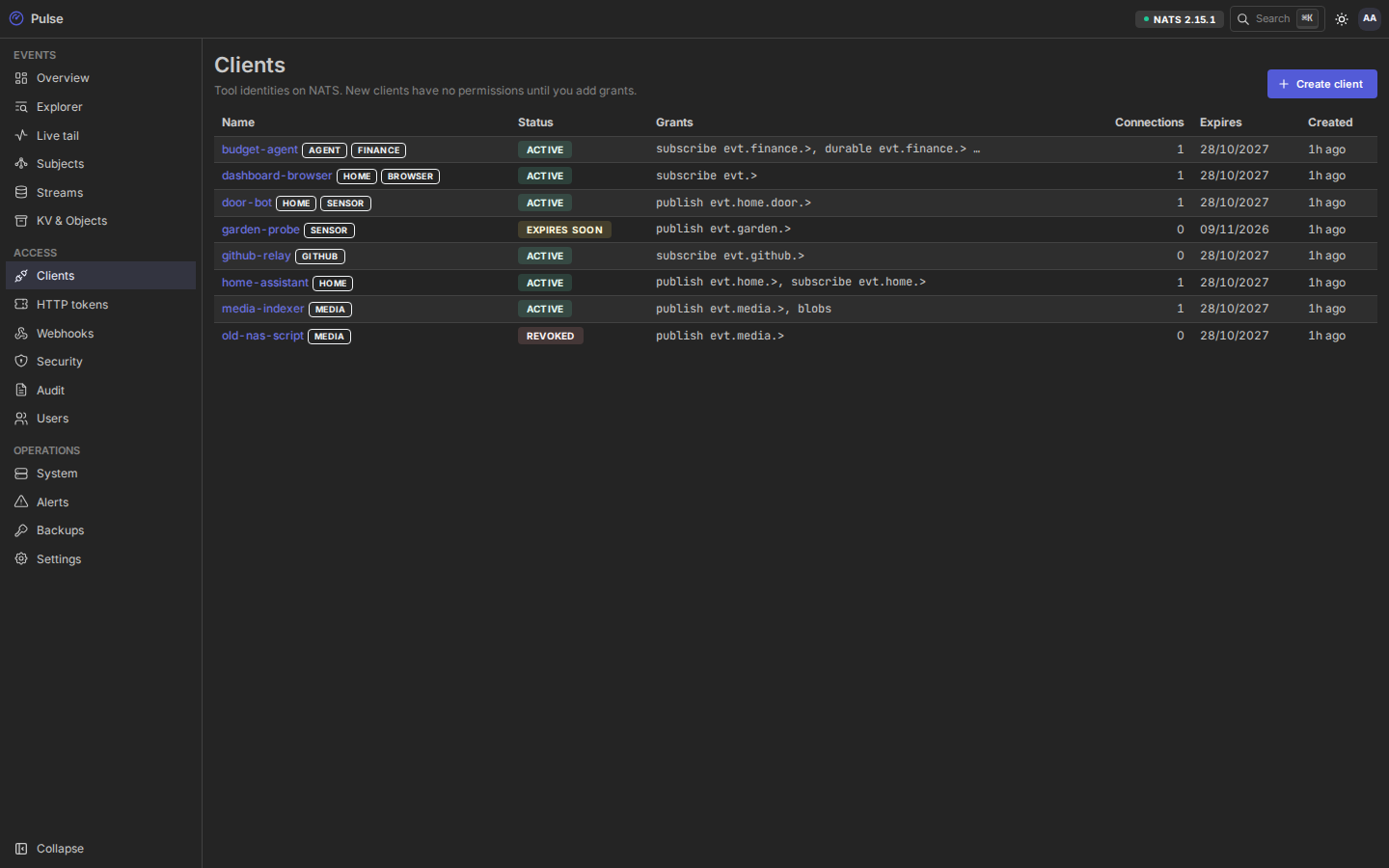
A client is one tool's identity: a NATS user with its own credentials (.creds) and a list of grants. Every tool should get its own client. Revoking one tool then never affects another.
Least privilege by default
A new client has no permissions. It can connect, but it cannot publish, subscribe or replay anything until you add grants. pulsed turns grants into NATS permissions inside the client's user JWT; NATS enforces them, not pulsed.
| Grant | Fields | Allows |
|---|---|---|
publish | subject | Publishing to the subject pattern (JetStream acks come back on the client's inbox). |
subscribe | subject, optional stream (default EVENTS) | Core subscriptions on the subject, plus replay through ephemeral consumers on that stream filtered to the subject, and direct gets on it. |
durable | subject, name, optional stream | One named durable consumer, <client-id>_<name>, filtered to the subject. Create, read, delete and ack it. |
request | subject | Sending requests to the subject. |
reply | subject | Serving requests: subscribing to the subject and answering one reply per request. |
blobs | — | Reading and writing the blobs Object Store (large payloads, see the envelope). |
Subjects use NATS wildcards (evt.home.>, evt.*.door.*). A grant subject must start with a literal token; $… and _INBOX… subjects cannot be granted, and under _sys only _sys.alert.> (alert events) can be.
What is always denied
Whatever the grants say, a client can never:
- publish to
$SYS.>or$KV.>, or subscribe to them; - create, update, delete, purge, snapshot or restore streams, or delete or read single stream messages by sequence;
- call account, server or meta JetStream APIs;
- create a durable consumer through the legacy
DURABLE.CREATEAPI, or with a name its grants do not list; - use the unfiltered direct get on a stream (it would bypass the subject filter);
- touch Object Stores (
$O.>) without ablobsgrant.
Inbox prefix
Each client gets its own inbox prefix, _INBOX_<client-id>.>, instead of the shared _INBOX.>. Replies and JetStream acks to one client are invisible to others. The SDKs read the prefix from the .creds file. With the nats CLI, pass --inbox-prefix _INBOX_<client-id>, or every request ends in a permissions violation.
Durable consumers
Durables are optional. Without a durable grant, SDKs replay through ordered ephemeral consumers, which is what most tools need (since 24h, then live). Give a durable grant when a tool must resume exactly where it stopped and ack each event. The consumer name is always prefixed with the client ID, so one client cannot squat another's name.
Create a client
On the Clients page (operators and administrators): New client, a name, a description, tags and grants. Or through the tunnel with a personal access token:
pulse clients create door-bot \
  --grant publish:evt.home.door.> \
  --grant subscribe:evt.home.> \
  --grant durable:evt.home.>:door-bot-worker \
  --out door-bot.creds
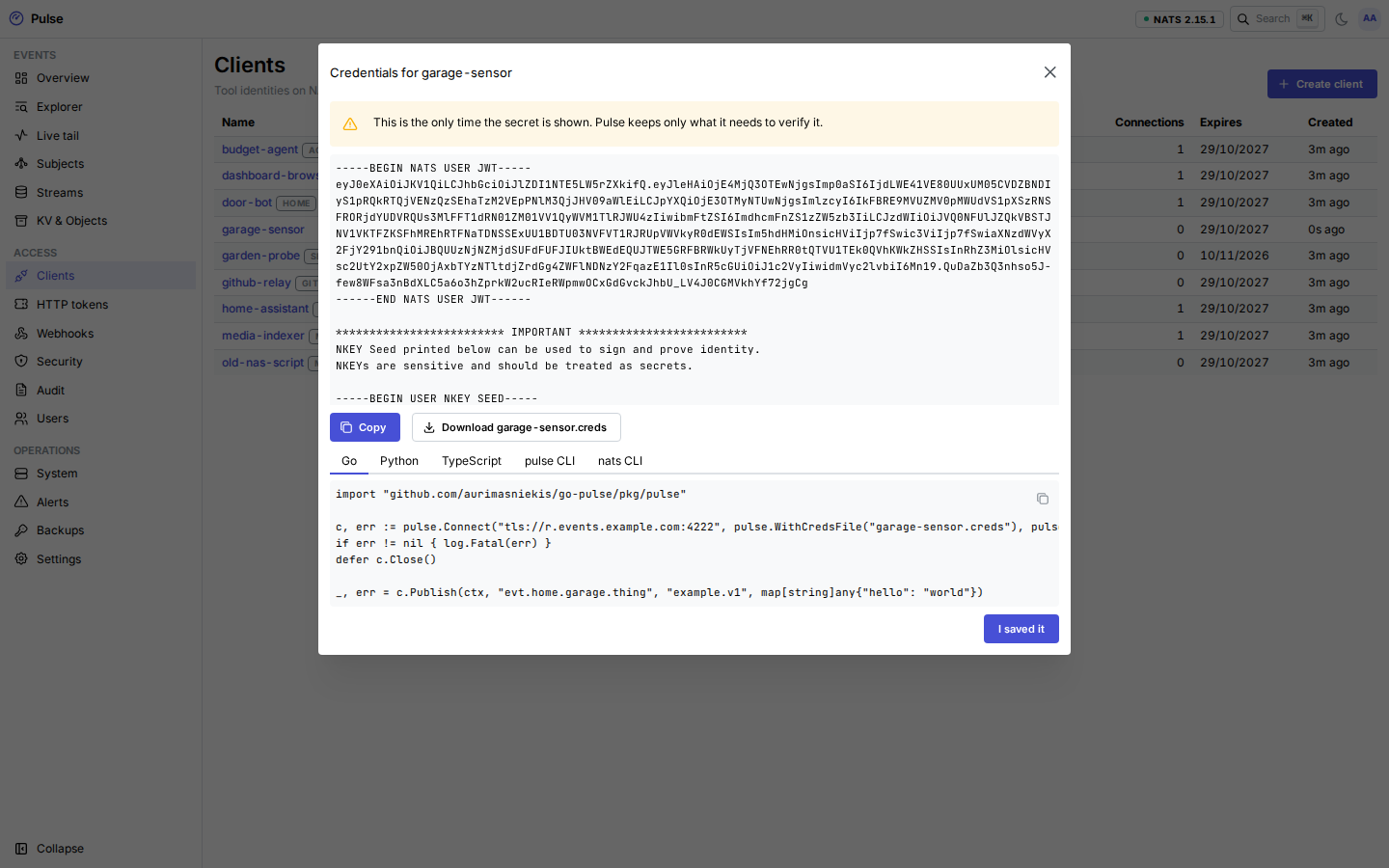
The grant format is action[:subject[:name]]. --days sets the lifetime (default 365). The .creds file is shown once: pulsed stores the user's public key, never its seed. pulse clients create refuses to overwrite an existing file and writes it with mode 0600.
Change, rotate, revoke
| Action | Effect |
|---|---|
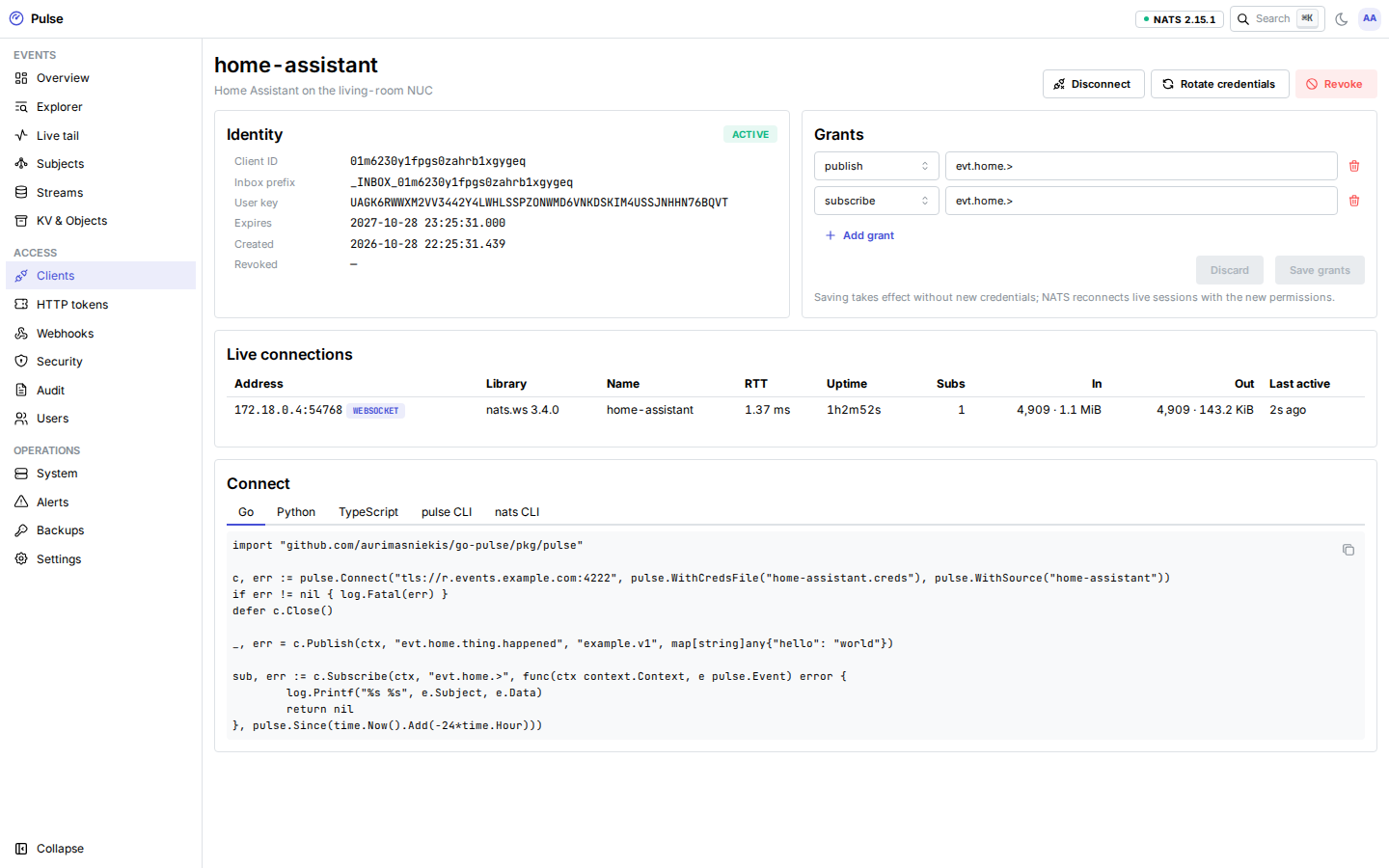
| Edit grants | New permissions take effect live. NATS reconnects the client's sessions; the creds stay the same. |
Rotate (pulse clients rotate <name>) | New creds; the old user key is revoked. Connected sessions with the old creds are disconnected within seconds. |
Revoke (pulse clients revoke <name> --yes) | Permanent. The user key is added to the APP account's revocation list and live connections are kicked. |
| Kick | Disconnects live connections now. The creds stay valid, so the tool reconnects. |
Credentials expire (365 days by default). The client_expiry alert fires 30 days before. An expired client shows as expired: rotate it to issue new creds.
The client's page lists its live connections (address, uptime, RTT, messages, bytes, subscriptions) from the NATS server.
HTTP tokens
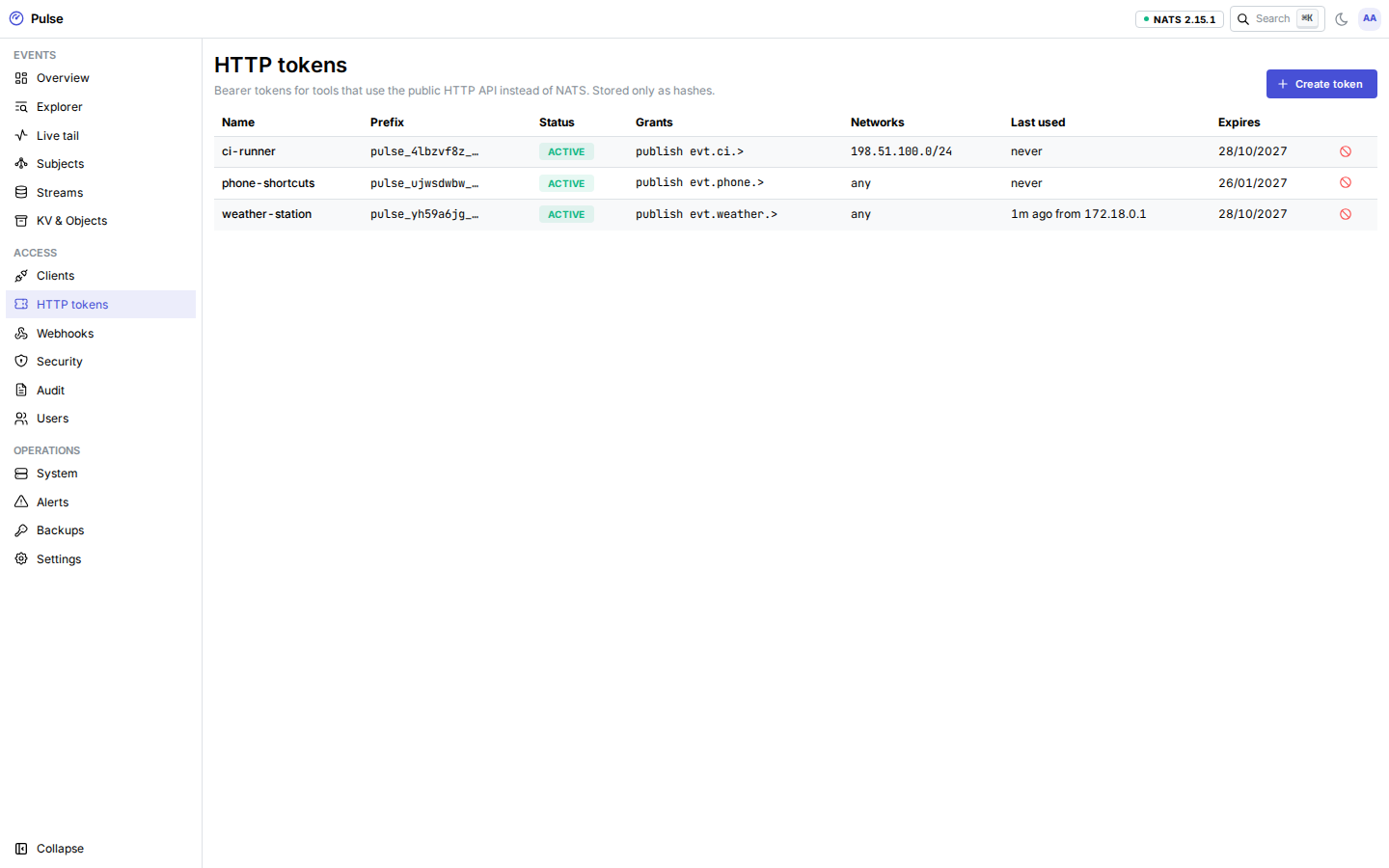
For scripts, CI jobs and services that cannot hold a NATS connection, create an HTTP token on the HTTP tokens page. Tokens use the same grant model (publish, subscribe, request) and work with the HTTP API on the public hostname.
- Format
pulse_<prefix>_<secret>. Only a hash is stored; the token is shown once. The prefix identifies it in the UI and the audit log. - Source networks: limit a token to IPs or CIDRs (
198.51.100.7,203.0.113.0/24). Empty means any. - Tokens expire and can be revoked. Last use time and address are shown.
- A missing or invalid token gets 401 and counts toward a ban for that address. A valid token without the grant gets 403 (no ban).
Audit log
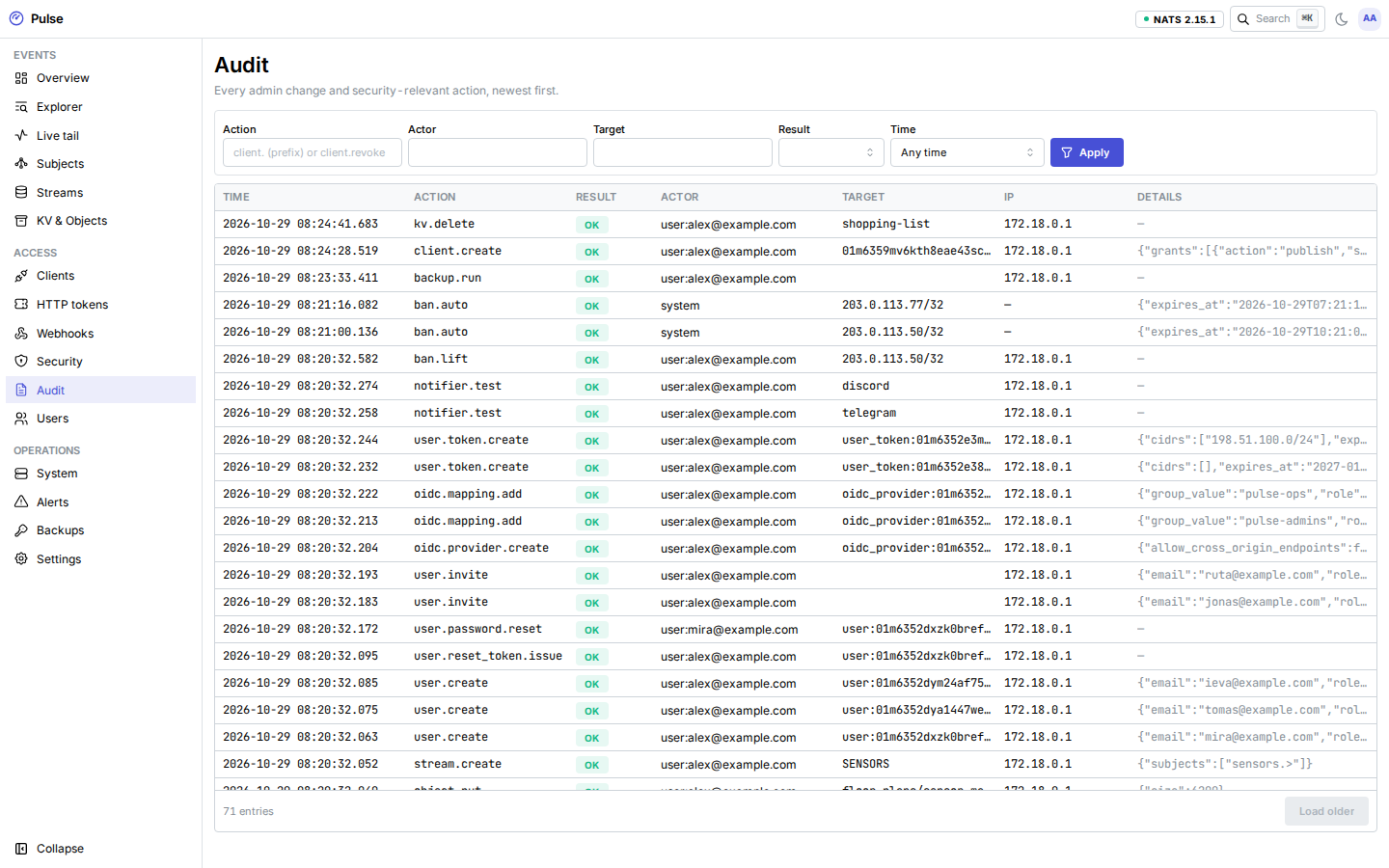
Every change made through the dashboard, the admin API, pulsed admin or pulsed keys export is written to the audit log in SQLite: client and token changes, grant edits, rotations, revocations, stream and bucket changes, webhook changes, bans, backups and restores, alert rule edits and admin publishes. Secrets are never recorded.
The Audit page filters by action (exact, or a prefix such as client.), actor, target, result and time range.